100 boxes: Looking back over 30 years
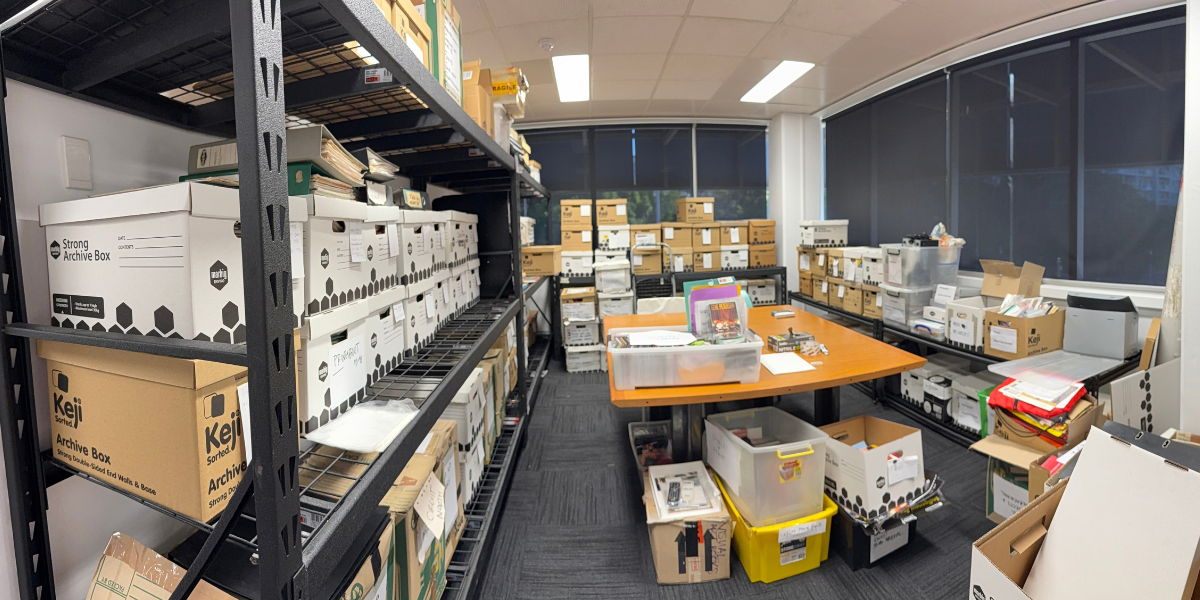
What does 30 years of arts touring look like?
In our Darwin office, part of the answer is stored in more than 100 archive boxes. There are posters and flyers, photographs and slides, exhibition catalogues, CDs and DVDs, old VHS tapes and even floppy discs. There are tour itineraries, installation manuals, artist biographies, media releases, newspaper clippings, budgets, contracts, grant applications and handwritten correspondence.
Together, they tell a much bigger story: three decades of artists, artworks, performances and ideas travelling across the Northern Territory, Australia and beyond.
Earlier this year, following Artback NT’s 30th anniversary, we commissioned Dr Fiona Starr of Australian Lived Histories to undertake the first formal significance assessment of the Artback NT Program Archive.
After 30 years, we needed to take stock of what we have, understand what was most important, and think carefully about how the collection should be cared for, documented and made accessible in the future.
But the assessment also gave us an opportunity to look at the archive differently, not simply as a record of Artback NT, but as part of the wider history of arts and cultural development in the Northern Territory.
Artback NT’s archive began forming almost accidentally. From the organisation’s earliest programs in the 1990s, staff kept the material generated through developing and touring exhibitions and performances. Over time, they became a remarkably detailed record of how work was created, presented and moved between places.
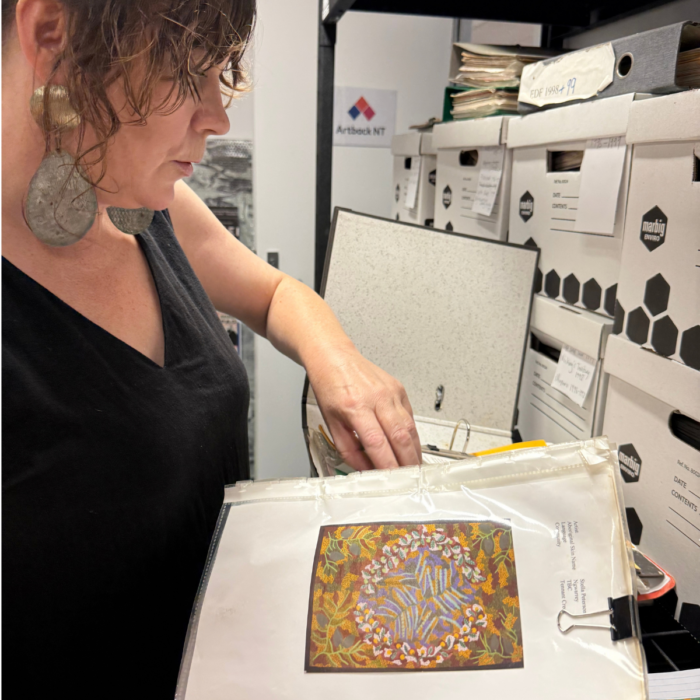
A history of Artback NT, told through the archive
The earliest Artback NT material dates to the mid-1990s, when the organisation was established as the Northern Territory’s National Exhibitions Touring Support agency. Early files record visual arts exhibitions travelling between galleries, art centres, towns and communities, including Printabout, Artback NT’s first full-scale visual arts exhibition, which began touring in 1996.
The organisation then amalgamated with performing arts touring body Circuit North in 1998, and by 1999, Artback NT had produced its first performing arts program with Coloured Stone. The archive begins to expand from there.
The collection also traces Artback NT’s growing presence across the Territory. A visual arts office opened in Alice Springs in 2003, and in 2007 Artback NT established its Indigenous Traditional Dance Program. DanceSite grew from that work and was later developed in Tennant Creek and Borroloola, where it became Malandarri Festival, now an important community-led celebration of dance, music, language and culture.
As Artback NT’s program expanded, so did the archive. The boxes trace exhibitions, performances and cultural exchanges travelling across the Territory, interstate and overseas.
Artists and stories held in the archive
The archive also brings together material relating to an extraordinary range of artists and groups whose work has helped shape the cultural history of the Northern Territory and Australia.
There is material relating to George Rrurrambu and Warumpi Band, pioneers of Aboriginal rock from Central Australia; White Cockatoo Performing Group, whose performances took culture from Arnhem Land to audiences around Australia and overseas; and B2M, the Tiwi Islands band whose touring included performances across Australia and international cultural exchange.
The archive also traces the careers and projects of artists including Yothu Yindi, Shellie Morris, Djuki Mala, Hand to Earth, and many others across music, dance and theatre.
In the visual arts, the collection contains material connected to artists and curators including Brenda Croft, Michael Riley and Benjamin Warlngundu Bayliss, alongside decades of exhibitions involving artists and art centres from across the Territory.
What survives is often much more than a poster or photograph. There are contracts, tour schedules, correspondence, media coverage, catalogues, installation plans and other records that reveal how work developed and travelled, and the relationships that made it possible.
Technology across the years
The archive also captures a quieter history: the changing technology of arts touring.
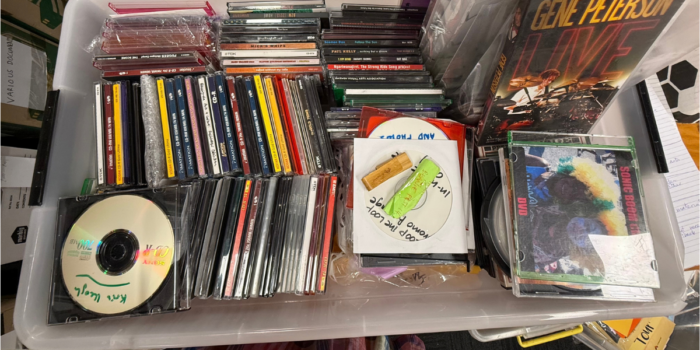
Slides and photographic negatives sit alongside VHS tapes, floppy discs, CDs and DVDs. Handwritten notes, printed correspondence and old tour books gradually give way to hard drives and digital files.
The formats have changed dramatically. Much of the underlying work has not: developing projects with artists, working with communities and venues, navigating vast distances, finding audiences and working out how to get NT art from one place to another.
A collection of national significance
The independent assessment found the Artback NT Program Archive to be unique in Australia.
In particular, it identified the Indigenous programs and materials held within the collection as being of national significance, documenting decades of work with First Nations artists and communities and the development and touring of work from the Northern Territory.
The collection was assessed for its historical, aesthetic and social significance, as well as its rarity, completeness and potential for future interpretation and research. That significance comes not from any single object or project, but from the collection as a whole.
It documents not only the work that audiences eventually saw, but the processes that made it possible, including work developed in and with remote communities.
It also preserves the smaller details that are so easily lost: who was involved, where something travelled, how it was installed, what audiences saw and how a project developed along the way.
What happens now?
The archive is still a work in progress.
Some parts have already been sorted and documented, and Artback NT’s poster collection has been digitised. But there is much more to do: cataloguing, identifying priority material for digitisation, improving storage and documentation, and working through questions of appropriate custodianship for some items.
The significance assessment gives us a clearer framework for that work and for future conversations about how the collection might eventually become more accessible. And as we work through it, we’ll be sharing some of what we find.
Because hidden among the boxes are not only records of Artback NT’s past, but countless stories about artists, communities and the ways Northern Territory art has travelled over the past 30 years.
The assessment was supported by the Community Heritage Grants program. The Community Heritage Grants program is funded by the Australian Government through the National Library of Australia; the Department of Infrastructure, Transport, Regional Development, Communications, Sport and the Arts; the National Archives of Australia; the National Film and Sound Archive of Australia and the National Museum of Australia.